

 Visdom Machine CI
Continuous Integration
at Agent Speed
Visdom Machine CI accelerates builds and tests to keep pace with continuous agent-driven development.
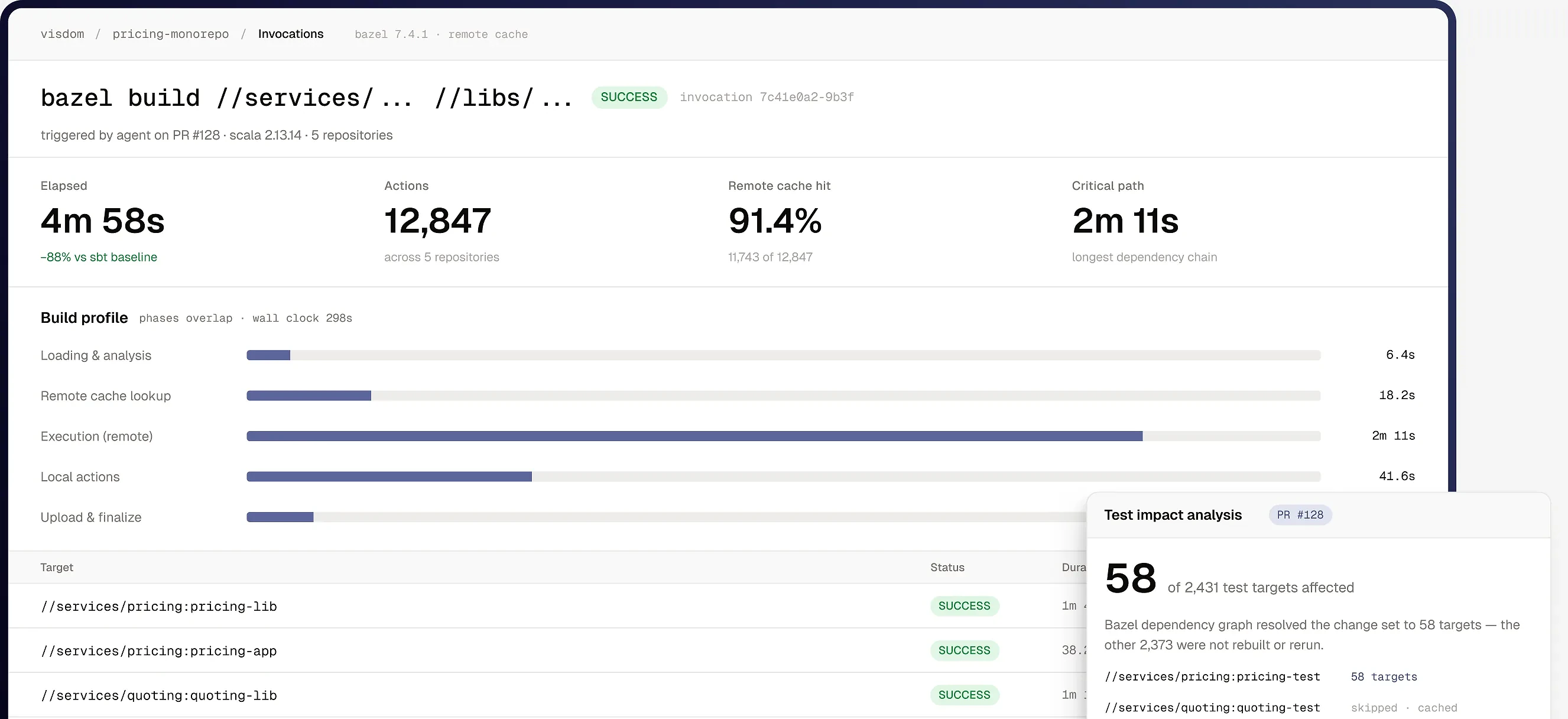
AI agents move at machine speed. Most CI systems do not.
AI agents generate and validate changes continuously, but most CI pipelines were designed for human development workflows. Slow builds, large monorepos, and delayed feedback quickly become bottlenecks, limiting agent iteration speed and increasing infrastructure costs.
Optimizing CI for autonomous software delivery
Visdom Machine CI applies build acceleration techniques developed for large-scale engineering organizations. Using Bazel, caching, selective test execution, monorepo optimization, and CI orchestration, it reduces feedback cycles and keeps validation aligned with agent execution speed.
−88%
build time reduction
Global logistics, Scala monorepo, sbt → Bazel. 40–60 min → 5 min.
−43%
PR merge time
Investment bank, Scala monorepo, managed IntelliJ IDEA.
~50x/hr
agent iteration speed
The cadence today’s pipelines need to keep up with.
Based on VirtusLab client data under NDA.
The goal is to make continuous integration operate at machine speed so agents spend less time waiting and more time delivering working software.
Build acceleration, proven at enterprise scale
Build Acceleration
Reduce build times through caching, incremental execution, and optimized dependency graphs.
Selective Test Execution
Run only the tests affected by a change instead of validating the entire system.
Monorepo Optimization
Scale CI workflows across large repositories while minimizing unnecessary work.
Bazel-Based Workflows
Leverage proven build-system techniques designed for large engineering organizations.
Faster Feedback Cycles
Shorten validation loops so agents can iterate continuously.
Agent-Speed CI
Align build and test execution with the pace of autonomous software delivery.
Agents spend less time waiting and more time delivering working software.
- Faster Build Times
- Faster PR Validation
- Higher Agent Iteration Speed
- Reduced CI Bottlenecks
- Lower Infrastructure Costs
- Continuous Integration at Agent Speed

Discover other Visdom Components
Rule the development of the agentic era






Technical Reference
Explore detailed technical documentation, implementation guidelines, and reference materials.